Biology has a language. It's written in nucleotide sequences, expressed through protein structures, and manifested in the transcriptomic profile of every living cell. At NovaGenAI, we build custom AI models that make biology machine-readable.
AI Reading Biology Like Language
Large language models are sequence-processing engines. They ingest ordered tokens, learn statistical relationships, and generate predictions. This architecture was designed for human language — but biology can be expressed as meaningful sequences too.
Pioneering research like Google's Cell2Sentence demonstrated that multi-dimensional biological data can be converted into structured sequences that LLMs can ingest and reason about. We're building on these foundations — training custom models on proprietary biological datasets to solve specific enterprise problems.
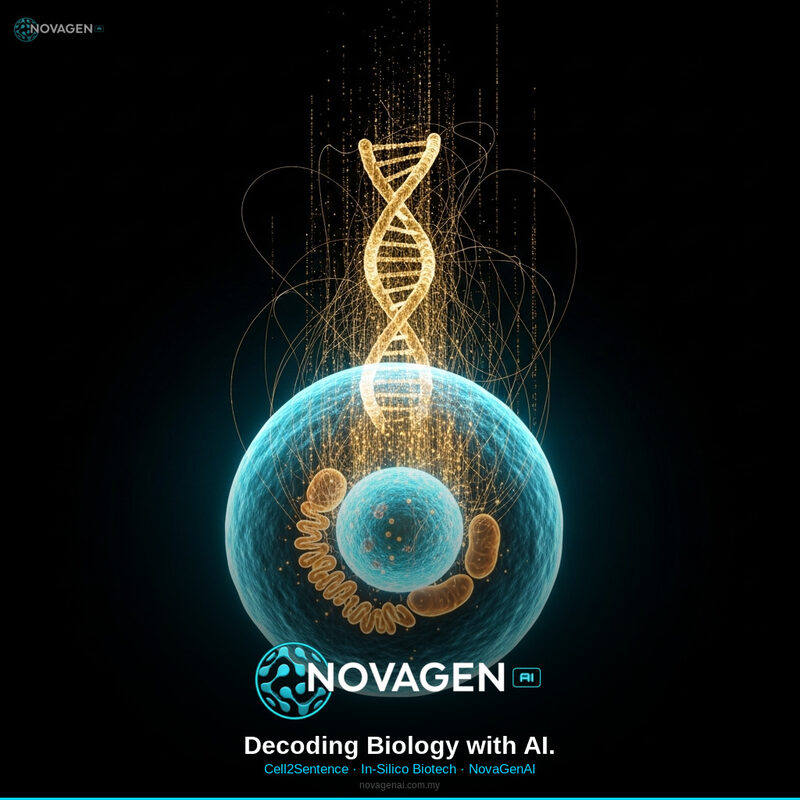
Multi-Omics: The Full Picture
Our models integrate multiple biological data layers: transcriptomics (gene expression), genomics (DNA sequences), epigenomics (gene regulation), proteomics (protein expression), and metabolomics (small molecule profiles).
The relationships between these layers — how epigenetic state influences transcription, how transcription drives protein expression — are precisely the kind of complex dependencies that transformer architectures excel at modelling.
Why Stem Cells Are Ideal Training Data
Stem cells are uniquely information-rich. They exist in dynamic states — proliferating, differentiating, responding to signals, making fate decisions. A single culture can produce thousands of distinct cellular states, creating an extraordinarily rich training corpus.
Where a static tissue sample gives you a snapshot, stem cell data gives you narratives — trajectories of cellular change the model can learn to predict.
Accelerating Drug Discovery
The pharmaceutical industry spends $2.6 billion and 10–15 years per drug. Most of that cost is failure. Our models attack the failure rate at its root.
A model that has learned cellular biology can predict drug responses without physical experiments — screening millions of candidates in hours, identifying off-target effects, and entering the lab with higher-confidence leads. Even a modest reduction in preclinical failure rates means hundreds of millions in savings.

What We're Not Claiming
Our models are not diagnostic tools. They don't make clinical decisions. They're research platforms — new ways of representing and reasoning about biological data. Their outputs are hypotheses to be tested, not conclusions to act on without validation.
What's Next
Over the next 12 months, we will scale training to larger multi-omics datasets, publish benchmark results, deploy inference to partner laboratories, and extend the framework to additional biological domains. The future is computational — and it's closer than you think.